Exploring the intersection of the world’s religious and spiritual traditions with environmental policy and practice.

Contrary to the expectations of the “secularization hypothesis,” religion has not declined in the technological age, and thus remains a vital variable for understanding socio-ecological dilemmas.
I use qualitative social science methods, such as critical ethnography, case studies, environmental histories, and interviewing. I seek to understand how people derive and create meaning in relation to their surrounding environments. I explore how these meanings reflect, challenge, or resonate with received or novel religious teachings and institutions, and how such processes of meaning-making simultaneously create particular types of socio-natural places.
Specifically, I explore how small-scale, rural, and subsistence-based communities attribute noneconomic values to various aspects of the landscape, and how related perceptions and practices engage with, contribute to, or impede environmental degradation at the local, regional, state, and global levels. This approach challenges the fact/ value distinction that places ecological science in the realm of quantitative and confirmable science, and values and morality in the voluntarist, subjective realm.
Current projects include:
Peak to Paddy: Glacial Lifeways Monitoring Research: With colleagues and students at Jigme Singye Wangchuck School of Law and Royal Thimphu College in Bhutan, we will study mountain communities’ experience of climate change from high elevation headwaters to fertile lowland plains, along two major Bhutanese river systems, with the goal of developing resilient, relational, and inclusive responses to glacier decline and extinction. While abundant scientific research has demonstrated the material consequences of climate change, less is known about how local people experience, explain, and respond to changes on and in culturally significant mountains and mountain glaciers. The project will involve student researchers in data collection, building their professional skills and experience. Students will explore how the practices traditional ecological knowledge have supported adaptation and resilience in extreme mountain environments and change. This project, currently in development, has become extremely salient since the August 26, 2026 landslide, glacier collapse and catastrophic flooding in nearby Nepal.
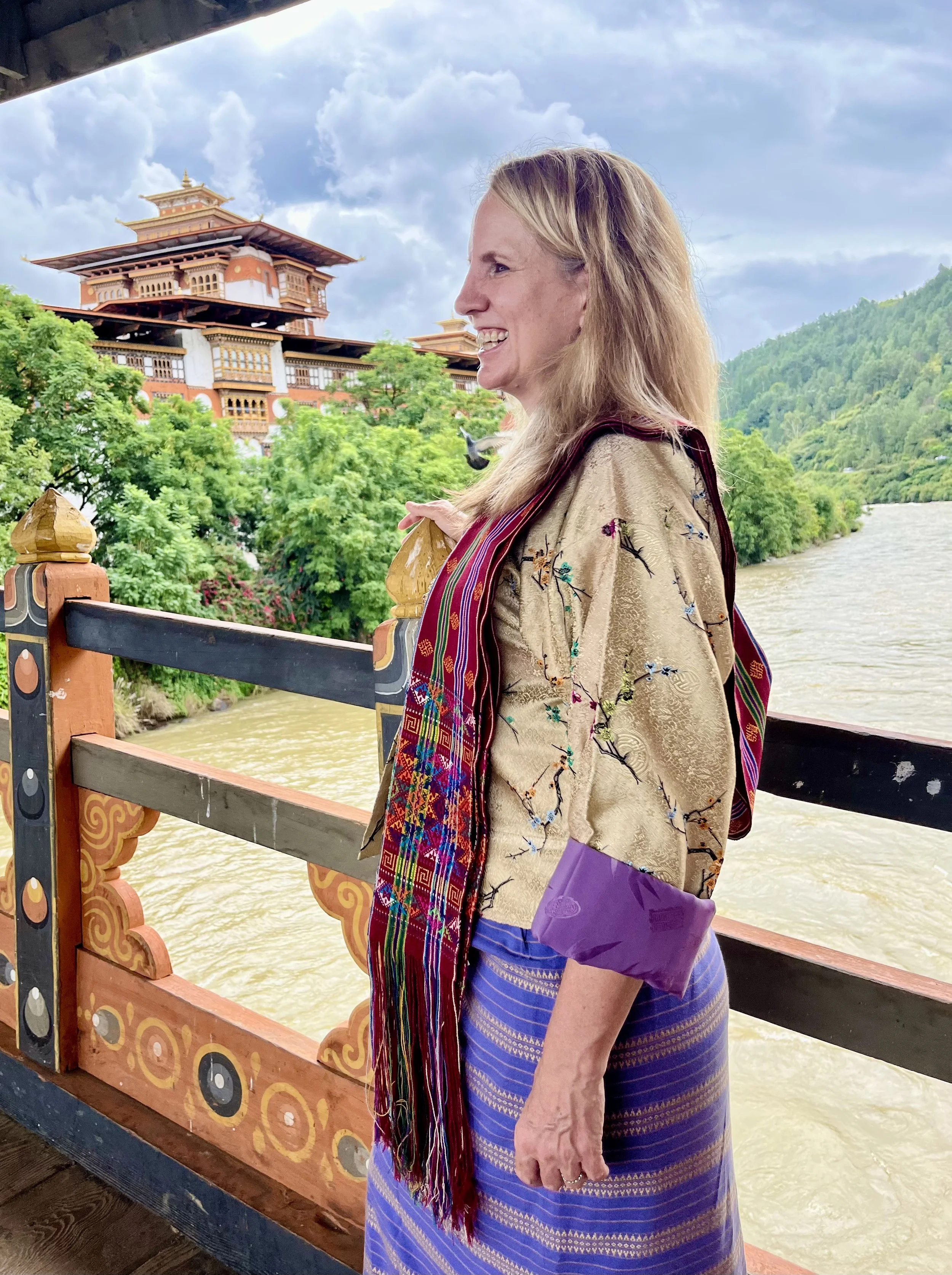
Thunder Dragon Ecology: Lessons from Bhutan for a Flourishing Future, a book manuscript that reveals the powerful influence of local religious and spiritual values in promoting culturally relevant environmental conservation and development policies and practices in carbon-negative, never-colonized Bhutan, which faces extreme climate change risks. Bhutan’s development path shows that alternative trajectories that incorporate moral values for nature are possible. Systemic change, as called for in the 2023 Interfaith Statement for COP28, need not be built from scratch but can turn toward existing policies, practices, institutions, and worldviews that recognize the ecological embeddedness of humanity. Some key aspects of this study are summarized in Religion and Ecology in Bhutan in the Oxford Research Encyclopedia of Asian History. At the Fourth International Conference on Vajrayana in 2022, organized by the Centre for Bhutan and GNH Studies in Thimphu, Bhutan, I spoke about Sanctifying the Himalayan Landscape and in 2024, I presented An Epistemological Expedition into Vertiginous Animate Terrain.
Vanishing Gods: Cultural Impacts of Glacier Loss, a developing book manuscript and ongoing research that examines the role of cultural values in adaptation and resilience in mountain regions experiencing glacier decline and disappearance. Glacier decline has significant cultural and spiritual effects for high mountain communities, initiating transformations in the ways that local people understand themselves and make meaning in relation to their surroundings. Outputs from this project include: numerous presentations, The Spiritual Significance of Glaciers in an Age of Climate Change (WIREs Climate Change, 2015); “Dragons of Fortune: Glaciers as resource sentinels and portals” at the American Academy of Religion in 2024; a panel on The Value of Glaciers at the International Mountain Conference in 2025; Traditions Shaken by Global Warming (UNESCO Courier 2025); Melting Ice and Transforming Beliefs (Nature Climate Change 2026).

FEATURED TOPICSResearch, Articles & Public Lectures

Human Health and Ecological Resilience
The COVID-19 pandemic continues to more fully reveal injustices, inequities, and imbalances that contribute to climate change, ecological degradation, and economic instability that threaten our individual and collective well-being. This potent time invites us to consider questions like: How can we cultivate individual, collective, and ecological resilience in this unstable new reality? What lessons does the pandemic offer for addressing climate change and human health?

On Ecology and Spirituality
Dr. Allison gave a lecture “On Ecology & Spirituality” as part of the California Institute of Integral Studies’ Big Ideas lecture series in January 2020.
READY TO COLLABORATE?